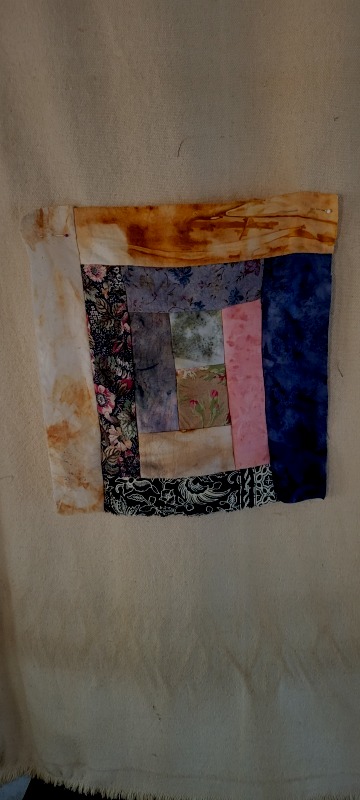
 so…there's Umwelt. and then, one more thing….the Richardson effect. i can't go forward till i am settled enough within these two "things". He, James Bridle, is the consummate story teller. Here is how he told me this. at first paraphrased from pages 101 and 102 of Ways of Being.
He tells of a meterorologist, Lewis Fry Richardson who was also a Quaker, a pacifist who during the first World War was a conscientious objector who served on the front lines as an ambulance driver. During the long hours between sorties, he worked. with paper and pencil to formulate the movement of airmasses and gradients of atmospheric pressure.
"In a series of books published late in his life, Richardson sought to discover a mathematical basis for the causes of war and the conditions for peace. One of his ideas was that the propensity for war between two states might be a function of the length of their shared border. In order to prove his hypothesis he needed accurate figures for the length of those borders, but found that such figures did not exist; no estimate of any one country''s border seemed to match any other. The deeper he dug into the problem, the more elusive, and the more conflicted, such estimates seemed to be.
he subsequently identified a paradox: the more accurately you try to measure some things, the more complex they become. This surprising observation has become known as the Richardson effect. Imagine taking a kilometre-long ruler and measuring the coast of Britain. Now repeat the exercise with a ruler half as long, then half as long again, and so on. On each measurement, the reading would get more accurate, with more and more of the coastline accounted for. But the result, as Richardson realized, was not that the measurement converged on the correct answer but rather, the more closely it was measured, the longer it got. What Richardson had discovered was what the mathematician Benoit Mandelbrot would later term 'fractals': structures which repeat to infinite complexity. Instead of resolving into order and clarity, ever closer examination reveals only more, and more splendid, detail and variation.
The Richardson effect applies to biology, archaeology and biological tools and, it seems, to life itself. As our archaeological and biological tools get better, as we unravel the web of life, the result is not an ordered tree, with measurable branches and clear delineations between forms and types, but a whirling dance of encounters and interrelationships. The species start to fragment and blur; the field, from savannah to tundra and back again, fills up with players. The mud's churned up. The referee can't keep score any more. It's beautiful, this teeming world of ancestors and progeny, this utterly animated free-for-all, this breaking down of boundries. This is what the close scrutiny enabled by our technology actually reveals: not a rigid map, but a pattern of interference, all the way down to the quantum dance of the energy field behind everything. " ~*~
and…just one more thing, one more story…. paraphrased. to give more picture of how he writes.
on 28 March 1838 Charles Darwin visited London Zoo to see an orang-utan named Jenny. Jenny was one of the first such apes that people in Britain had seen. he was allowed to enter her enclosure. He wrote to his sister about her. This was 20 years before he would publish On the Origin of Species. He returned to the Zoo in subsequent months bringing Jenny small gifts each time. a mouth organ, some peppermint and a sprig of verbena.


Leave a Reply