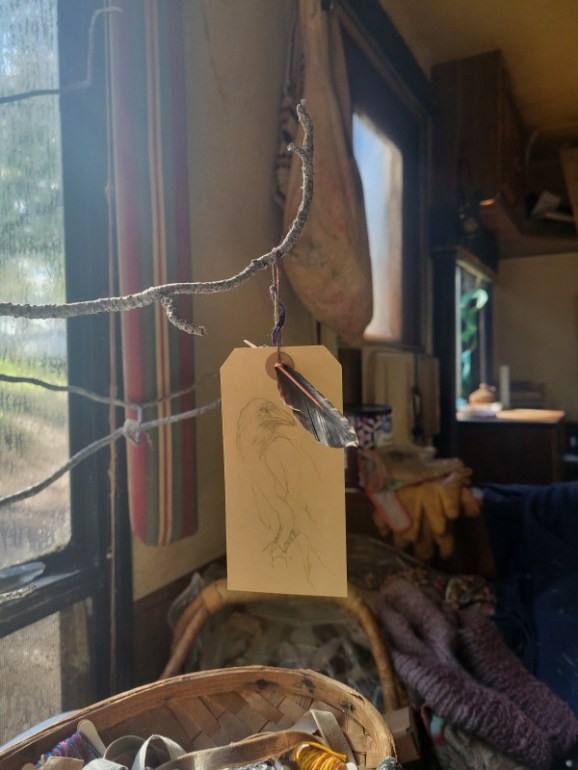
20230330_095927

morning in the Tin House.

i'd wanted to talk about Storks Bill.    but

Erica Heilman.    Rumble Strip VT.com     the first in a series:    What Class are You?   

i hold her in such Love and High Regard.     that she found a question that can OPEN to so so many threads,  such vast array of possibility for thought, wondering and conversation.    so just to say i hope you find it as amazing as i am,   it all  being So Much and can't be explored here….it takes a

conversation

back and forth  and this format doesn't allow that.   But i hope you can go there and then talk to your Self or those with whom you do converse .     It's Beauty Full.


Posted in

12 responses to “how a question can OPEN so much”

  1. Marti Avatar
    Marti

    Well I hope it is ok with you grace that I bring the conversation here. Commenting on blogs is not the same as having a face to face conversation but I do hope some of you who come here, will chime in with your own experiences based on this subject matter. This conversation is important and I want to bring it here for personal reasons:
    The woman Erika interviewed, Katrina, who worked at the general store, was smart, eloquent and matter of fact about her life. She identified as working class and clearly saw and felt, the delineations between stature, working class, poor and upper class, etc. She believed that when you are born, who you are born to, determines your destiny, how it is already set for you.
    She spoke of the difference between students who did well academically, who participated in extra curricular activities and attributed that to students who had families who took interest in their schoolwork; how they had dinner together every night, discussing their days instead of working parents who told their kids to fix their own dinners…
    When asked if she was offended by the question of class, she said poor people would not be but the rich would, because they would feel the need to defend themselves. I do not want to give time to the former evil that was our President, but Katrina noted that he wanted to divide “us” and how he kept that division going, how she felt he wanted to get rid of the poor or put them on an island. When asked why then, do the poor,support him, she spoke of how the poor want to be like the rich, to be able to buy what you want, when you want, etc.
    She was real and she was moving when she spoke of her hardworking Dad who would never be able to go on a vacation, would never have the things that the rich have, probably did not have good health care, and at the end of the day, would drink. Drinking at the end of the day was how you faced your life, you wanted something to make you feel better.
    Why have I brought this here:
    I have done so because I identify with working class but I also, based on my own life, have a different experience with the label of “poor”. Obviously, times are different and life is so much harder and fraught with so many more difficulties, at every level, than when I was growing up. My Mom was a stay at home housewife, my Dad worked three jobs, as a janitor for the Bank of America, the local drug store and my high school. We never had a car and I was 13 before we got a TV. This may have set me apart from my classmates. Still, we had marvelous vacations, riding the train to San Francisco (we could walk to the train station from my home.) Growing up without a TV until I was a teenager, was in some ways enriching because I had a radio, we had a phonograph, many records and music was part of my daily life as was dancing. My parents loved to dance and passed that love onto me.
    My Dad was given a gift subscription to National Geographic magazine by one of his employers and that, plus getting my library card when I was 7, opened the world to me. My uncle had a car and almost every weekend we would pack a lunch and he would take us on drives to see trees and butterflies and wild flowers and hills and mountains and once in a while, the ocean.
    I never went hungry, always had nice clothes, many homemade, knitted or hand me downs from my cousin. My parents taught us how to garden and a lot of our food was grown by them in our little home, owned free and clear that they saved in the first five years of their marriage to purchase.
    Here is what may be a distinct difference between my life and Katrina. I am the child of immigrants who came to American from Spain. Most immigrants want better lives for their children and we were no exception. My parents believed that you make your own destiny, are not born to it.
    As a family, we had dinner every night at the table and my parents always wanted to know how my sister and I did in school each day. They could not help us with our homework but wanted to know about what we were learning. Education was very important to my parents as my Mom only went to the first grade before having to help take care of the family’s herd of sheep. My Dad’s Mom died when he was 3 but his stepmother wanted him to go to Jesuit school to become a priest. He did so but had to drop out after the third grade to help with the family farm.
    Growing up I never felt “poor” but there was also that resolve to do well in school, to make my parents proud, and to prove to myself that I was as gifted as the rest of my classmates.
    One of the most important gits that my Dad gave me was this: He believed that a person was rich not by how much $ he had but how much kindness he put out into the world.

    Like

  2. CatherinE Avatar

    I will listen, Grace. I subscribed to her podcast so I can listen more often.

    Like

  3. Deb G Avatar

    The link: https://rumblestripvermont.com/2023/03/what-class-are-you/
    I am thinking about conversations. Where and when we choose to have them, who we have the conversations with… The types of conversations we have with each other. The willingness to be vulnerable or the nothing to lose by sharing so why not say it… And the topic, I have lots of thoughts about this.

    Like

  4. Deb G Avatar

    Hi Marti, I am thinking about this…what I would say. One thought that I think you demonstrate and I think is shared in the podcast, is that class is so much more than financial. I never find labels easy…

    Like

  5. grace Forrest Avatar

    nothing to lose by sharing so why not say it

    Like

  6. grace Forrest Avatar

    am glad you subscribe

    Like

  7. jude Avatar

    the thread…

    Like

  8. Liz A Avatar

    when I first went into teaching the whole faculty was given an assignment to read a book entitled A Framework for Understanding Poverty … thinking back, I recall how it attempted to point out to educators as a “class” how hard it was/is to comprehend the challenges of living in poverty, what one needed to know to survive, but also how many hidden class identifiers were embedded in the middle class that we (assuming most teachers were middle class) took for granted … and the concept was further illustrated by posing scenarios that challenged us to consider how we in turn would be thwarted were we to try moving into the upper class … it was a humbling read as I honestly couldn’t envision myself anywhere but where I was … but also, to see more clearly how many assumptions I had of my students who were living a reality quite different from my own … and how hard it can be to break out of the stratum within which one is raised
    I will take this memory with me as I listen to rumble strip today …

    Like

  9. Tina Avatar
    Tina

    Looking back to my childhood being raised by parents who immigrated from Germany after the war honestly I never felt poor but did certainly feel different. My dad would repair our shoes with tires to replace worn out soles. My oldest sister got caught stealing shoes for us little ones because she felt so bad that other kids would make fun of us. I know it was harder for the older kids .. they have lots of stories about feeling poor .. we younger ones not so much.

    Like

  10. Faith Avatar

    I listened to this episode and learned from it, but also felt like something was missing. Marti nailed it. I, too, grew up poor, though I never knew it at the time and we were perhaps not too poor, as we did have a car and TV. I think my mom probably grew up middle class, but my dad’s family were farmers and definitely poor. My dad had two jobs for a long while. Once my little sister was in school, my mom also worked and got home after my dad did. We still all ate together, though as we got older my sister and I did a lot of the weekday cooking. We never went on vacations, but still did things as a family (minimal cost or free). [I remember going to see Swiss Family Robinson (one of the first Kodachrome movies) on a huge screen, free or discounted because my dad worked at Kodak.] Education was also important in our family, and both my parents passed on a love of reading. I think things like this are necessary. Basically, our pocketbook was poor, but our hearts, our lives! were rich.
    But what I heard in this episode (most particularly Katrina) was poor hearts/lives. A sense of giving up that goes beyond accepting financial poverty. I do not understand how being poor provides any excuse for not having dinner together–even if you don’t have a dining table. Or that “working class” = “poor.” (My husband and I are definitely working class and not rich, but financially comfortable–ie. middle class>.) I suspect that some of the issues in Katrina’s life were not simply or directly due to poverty (though possibly can be traced back to it indirectly).
    Erica’s friend and the carpenter lady did not seem to have the same hopelessness Katrina expressed. Ethan was most insightful to me. His pauses and deep breaths sounded like my son, who has also had times when he didn’t know where his next meal was coming from and has a dream of a better life.
    I want to listen to more of these episodes, partly because I sense my own biases and blind spots. I want to learn more. I also want to talk with my son about this. Although his experiences in his adult life are similar, I wonder how much his middle class upbringing still slants his view.
    And more than simply understanding, I would like to know how to help and encourage younger people when I’m kind of a hermit/introvert who simply doesn’t know many people. While giving to the food bank and charities is good, it’s also pretty impersonal. Learning and understanding are only a beginning to bridging or closing the divide, politically, financially, racially, or wherever else. (and they all overlap)

    Like

  11. grace Forrest Avatar

    this is Sunday night and i am reading your words AGAIN and thinking…
    thank you, Faith, for your thoughtFULLness

    Like

Leave a comment